Tuesday, September 30, 2008
A Burning Pesticide Safety Question
PPI >PHI for Pesticide Safety
Monday, September 29, 2008
New Technology Directions for Pesticide Safety
Pesticide Industry CSR for CCD
Saturday, September 27, 2008
Global Action by Top Pesticide Professionals for Safety and Prosperity
Friday, September 26, 2008
A Bourgeois View of Pesticide Safety
Stewardship and Unity for Pesticide Safety
Thursday, September 25, 2008
The CCD Challenge for Pesticide Safety
Wednesday, September 24, 2008
A European View of Pesticide Safety in 2030
Monday, September 22, 2008
Telemedicine for Pesticide Safety
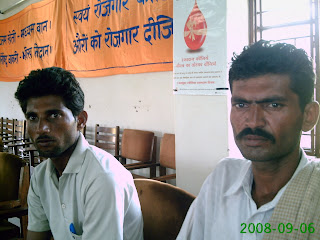
Regulars on this web log, and my friends in Kutch will recognize the master-cultivator pictured on the left. Please see my post of August 07, 2008 for details on how Pratap Saparia combines new technologies with traditional methods for some of the best farming to be found anywhere.Pesticide Safety Lead
Saturday, September 20, 2008
Italian Pesticide Safety
Thursday, September 18, 2008
A Pesticide Safety Lesson for the World
Welcome to Pesticide Safety
Wednesday, September 17, 2008
A Financial Perspective of Pesticide Safety
Tuesday, September 16, 2008
Toxicology Transparency for Pesticide Safety
Monday, September 15, 2008
The Future of Pesticide Safety in India
Sunday, September 14, 2008
Are Your Pesticide Stocks Safe and Secure?
Saturday, September 13, 2008
New Pesticide Safety Champion

Friday, September 12, 2008
Eternal Vigilance for Pesticide Safety in Production and Storage
Thursday, September 11, 2008
Fight Discrimination in Pesticide Safety Now
The Pesticide Action Network
I wish to respond to the material I have accessed today at the following link:
https://www.panna.org/
I have worked with Endosulfan, and with several other pesticides, bio-rational products, and organic technologies, for more than three decades.
Endosulfan does not harm non-target organisms or the environment when used as per label directions. The NOEL, ADI, and PHI systems are specifically designed to enable the safe and judicious use of pesticides.
Endosulfan has a unique place in Integrated Pest Management. It is the only molecule in the world with strains of beneficial insect tolerances. You are quick to report the EU ban on Endosulfan, but remain silent on CCD which afflicts the entire continent of
I appeal to you to serve the larger public interest, free of abusive discrimination, by promoting the safe and judicious use of pesticides.
Dr. Satyabroto Banerji
B 3 Industrial Assurance Building
Churchgate
Mumbai
400 020
skype: srbanerji
Call: 919820188291
http://pesticidesafety.
Please add your voice to mine. You can write to Panna at the following address:
panna@panna.org
Wednesday, September 10, 2008
Transactional Analysis for Pesticide Safety
Tuesday, September 9, 2008
Leadership for Pesticide Safety
Monday, September 8, 2008
Small Steps Can Make Major Pesticide Safety Leaps
Sunday, September 7, 2008
A Database is a Must for Pesticide Safety
Saturday, September 6, 2008
The Power of Consensus for Pesticide Safety
Friday, September 5, 2008
Recent European Initiatives for Pesticide Safety
Thursday, September 4, 2008
New Pesticide Safety Plane Takes Off
Wednesday, September 3, 2008
A New Pesticide Safety Dawn
Tuesday, September 2, 2008
Follow the Pesticide Safety Leader
Monday, September 1, 2008
Pesticides, especially foliar neonicotinoids and others with systemic potentials are suspect. However, they are patented properties of the most influential pesticide manufacturers from Europe. We cannot dare to challenge them, to say nothing of national regulators.
Honeybees can make a lot of noise, but who is willing to listen?

1. Promote the use of Endogram during flowering.
2. Use Endocel during the cool hours of the day when pollinator activity is relatively low.
3. Stop all systemic pesticide use a fortnight before a crop enters its reproductive phase.
4. Ban neonicotinoid foliar application during flowering.
5. Restrict systemic fungicides in favor of sulfur formulations.
6. Promote health bee programs.
7. Support the development of improved and tolerant honeybee strains.
My recommendations are inspired by the following link:
http://www.ars.usda.gov/News/docs.htm?docid=15572
Thank you for your vigorous, immediate, and sustained responses.
Allegations abound about connivance between regulators and the pesticide industry to foist harm on unsuspecting communities.
Controversies about the roles played by neonicotinoids to cause Colony Collapse Disorder in honeybees have caused widespread distress.
Every stakeholder in pesticide safety stands to gain if there are open discussions about the risks of using new and patented pesticides.
That is why I consider the contents of the following link to be a harbinger of positive change towards pesticide safety:
http://www.regulations.gov/fdmspublic/component/main?main=DocketDetail&d=EPA-HQ-OPP-2003-0254
Thank you for posting your valuable opinion on this matter of vital national interest.
The dead honeybee below cannot be brought back to life. However, you can save colonies from extinction by acting now to restrict non-essential foliar applications of neonicotinoids. Ask farmers to switch to contact molecules with favorable profiles for all beneficial insects during flowering. Substitution with Endogram will be even best.